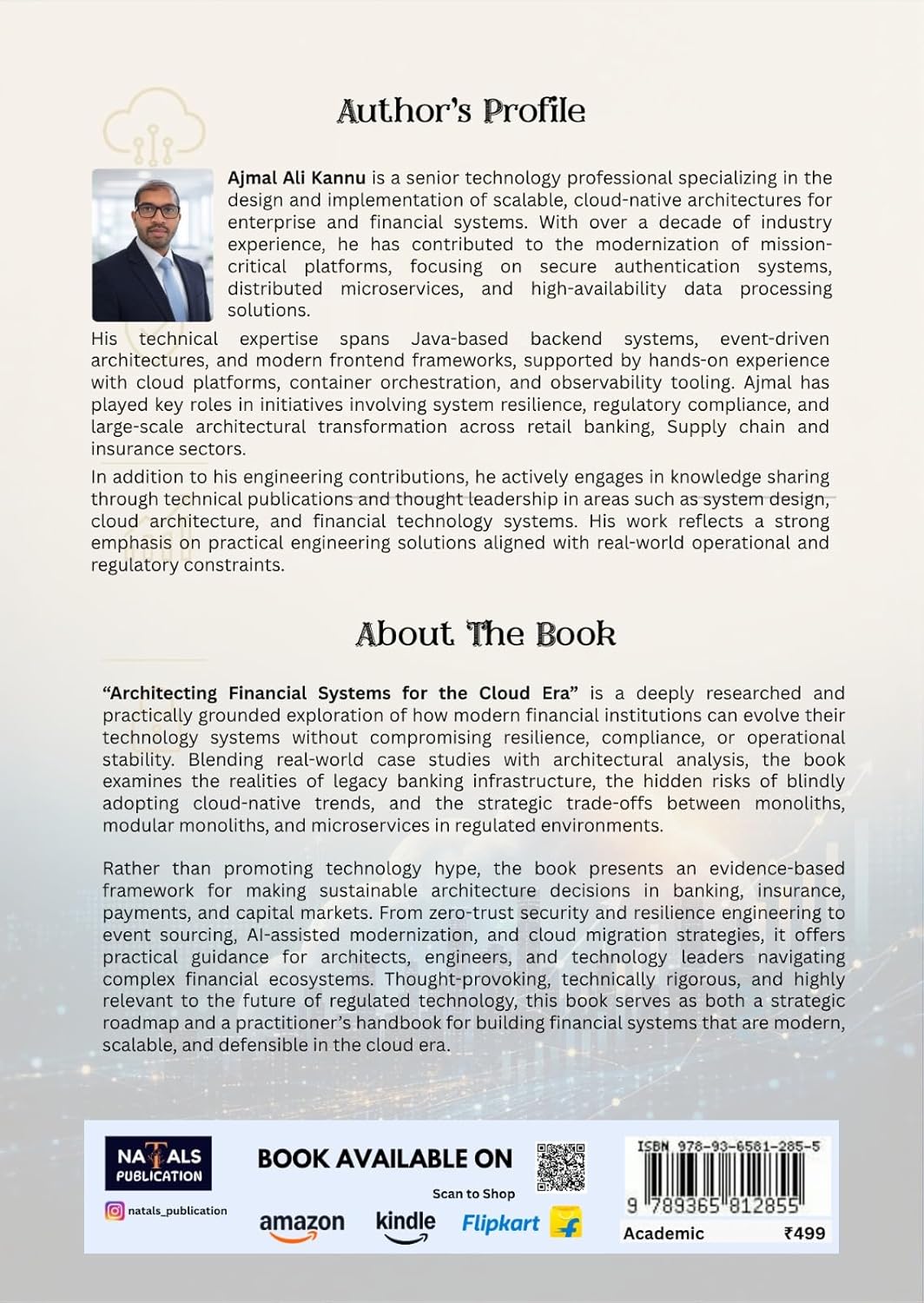
This book addresses one of the most consequential—and persistently misunderstood—problems in modern enterprise technology: how financial institutions should design and evolve their core systems in a world that simultaneously demands agility, regulatory compliance, and operational resilience. Every architecture decision inside a bank, insurer, or capital markets firm carries implications that ripple across years of operations, regulatory audits, and technology budgets. The industry has accumulated painful evidence that wholesale adoption of patterns popularized by high growth technology firms—microservices, cloud-native everything, event driven at all costs—does not transplant cleanly into environments constrained by Basel III, DORA, SOX, and the operational realities of twenty-year-old core banking platforms [1], [2]. Equally, there is a tendency within established institutions to deploy regulatory complexity as a shield against necessary modernization. That posture is demonstrably unsustainable. Competitors are accelerating. Customer expectations are evolving. Technical debt compounds silently until it becomes catastrophically expensive to service [3]. The most effective institutions navigate between these failure modes—applying modern architectural principles with disciplined awareness of the constraints that make financial systems engineering categorically different from general software development. What is absent from most architectural guidance in this domain is an honest accounting of trade-offs, grounded not in consulting idealism but in the physical reality of financial systems engineering. This book attempts to fill that gap. Where possible, it grounds its recommendations in peer-reviewed research, publicly documented case studies, regulatory guidance, and quantitative analysis rather than architectural fashion. Citations follow IEEE format throughout, reflecting the technical and engineering nature of the subject matter.