Dr. Papri Ghosh, Dr. Md. Ashifuddin Mondal, and Dr. Pushpita Roy
National Conference on Sustainable Innovations in Computer Science and Engineering (NCSICSE’2025), Volume 3
National Conference on Sustainable Innovations in Computer Science and Engineering (NCSICSE’2025), Volume 3
Couldn't load pickup availability
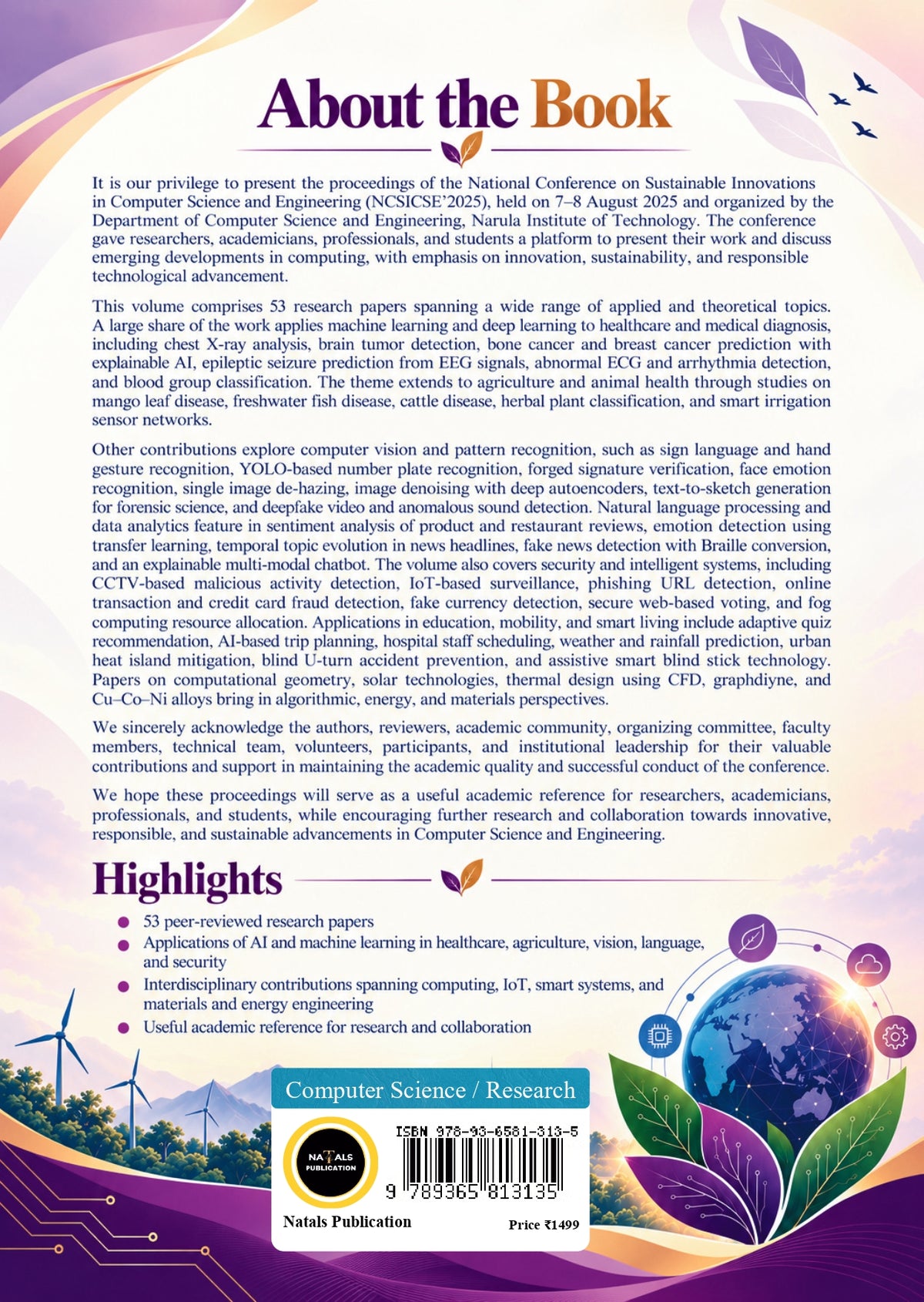
National Conference on Sustainable Innovations in Computer Science and Engineering (NCSICSE’2025), Volume 3 presents 53 research papers exploring contemporary developments across Computer Science, Engineering, Artificial Intelligence, Machine Learning, Deep Learning, IoT, cybersecurity, intelligent systems, and sustainable technology. The proceedings reflect the conference’s emphasis on solutions that combine technical advancement with efficiency, reliability, security, transparency, responsible deployment, and long-term societal relevance. The collection brings together scientific investigation and application-oriented research across healthcare, education, security, agriculture, industry, accessibility, environmental analysis, and intelligent computing.
It will enable you to:
- Explore 53 contemporary research studies across Computer Science and Engineering.
- Examine practical applications of Artificial Intelligence, Machine Learning, and Deep Learning.
- Study CNN, LSTM, ResNet, autoencoder, GAN, and other computational approaches.
- Understand applications of AI in medical imaging, disease detection, ECG analysis, and healthcare decision support.
- Explore Natural Language Processing, sentiment analysis, fake-news detection, chatbots, and text analytics.
- Review computer-vision applications involving surveillance, signatures, number plates, gestures, images, and deepfake detection.
- Study cybersecurity applications including phishing detection, secure voting, intelligent surveillance, and fraud detection.
- Examine IoT, Edge AI, fog computing, smart sensing, and connected security systems.
- Explore sustainable applications involving solar technology, urban heat islands, smart irrigation, agriculture, and energy-efficient design.
- Compare research methodologies, architectures, preprocessing strategies, model evaluation methods, and deployment considerations.
- Understand how computational innovation can be aligned with accessibility, sustainability, reliability, and responsible engineering.
Who should read?
- Undergraduate Computer Science and Engineering students.
- Postgraduate students and research scholars.
- Faculty members and academic researchers.
- Artificial Intelligence and Machine Learning practitioners.
- Data Science, Computer Vision, and NLP researchers.
- IoT, cybersecurity, cloud, edge, and software engineering professionals.
- Readers interested in sustainable and socially relevant technology research.
Share